

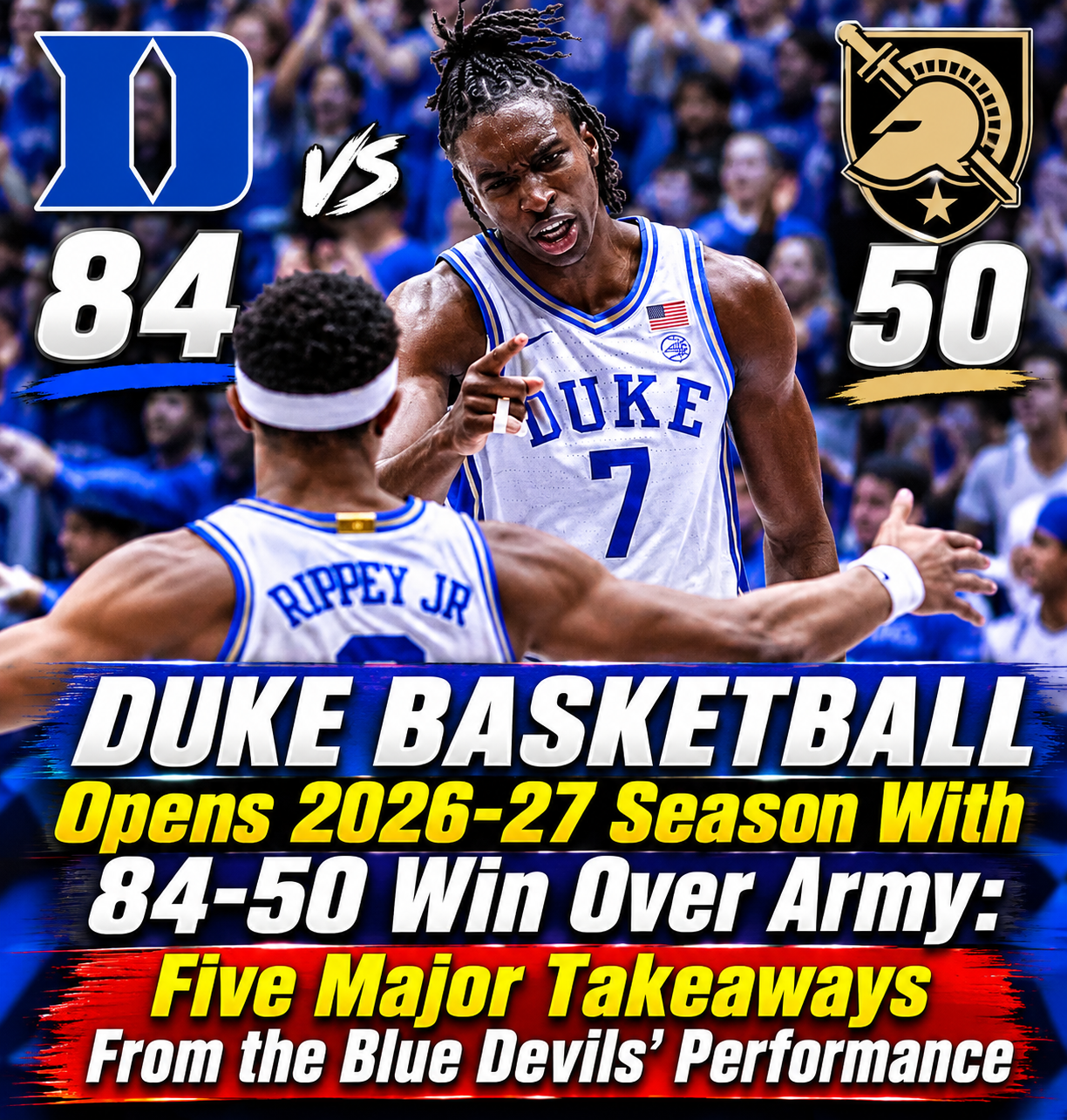
Duke Basketball Opens 2026-27 Season With 84-50 Win Over Army: Five Major Takeaways From the Blue Devils’ Performance
Duke basketball is officially back, and Jon Scheyer’s team began its 2026-27 campaign with a convincing victory at Cameron Indoor Stadium.
The Blue Devils defeated Army 84-50, using their size, athleticism and defensive pressure to control much of the season opener. However, despite the comfortable final score, the performance revealed areas that Scheyer and his coaching staff will want to address, particularly the team’s perimeter shooting and offensive organization.
Duke dominated inside, generated points from turnovers and received contributions throughout its rotation. Nevertheless, Army found opportunities to challenge the Blue Devils, especially when the visitors began connecting from beyond the three-point line.
Here are five major takeaways from Duke’s season-opening victory.
1. Duke Dominated the Paint but Struggled From Three-Point Range
Patrick Ngongba II opened Duke’s scoring account with a finish near the basket, setting the tone for an offense that relied heavily on its size advantage.
The Blue Devils continued attacking inside throughout the first half. Joaquim Boumtje Boumtje brought the Cameron Crazies to their feet with an alley-oop finish, while Dame Sarr followed with a dunk that generated another huge reaction from the home crowd.
Duke’s interior scoring was particularly effective because the team struggled to find its shooting touch from the perimeter.
The Blue Devils went 0-for-9 from three-point range in the first half, failing to make their first outside shot until the 24th minute of the contest. Instead of relying on perimeter production, they consistently attacked the basket and used their physical advantages to create scoring opportunities.
Scheyer acknowledged that Duke became too eager to score after establishing an early lead.
“I thought we got a lead and got a little bit antsy to score,” Scheyer said. “I think that’s human nature, but also you got to beat human nature, and you got to play the right way regardless of the score, so I thought that hurt us.”
The inability to consistently convert from outside remains an important area to monitor as Duke faces stronger competition.
2. Defensive Pressure Created Easy Scoring Opportunities
Although Duke struggled from beyond the arc, its defensive performance helped compensate for those offensive difficulties.
The Blue Devils repeatedly disrupted Army’s possession, intercepting passes and taking advantage of mistakes. Those defensive plays translated into 29 points off turnovers, giving Duke another reliable scoring source.
Sebastian Wilkins was particularly effective, leading the team with four steals. His defensive activity helped Duke turn Army’s mistakes into opportunities to attack in transition.
Scheyer was impressed with the guard’s approach and willingness to prioritize the team’s success.
“Sebastian probably just does the best job on the team when he’s in — he’s not thinking about anything else other than Duke winning,” Scheyer said. “I think that shows up with his steals, and he shows up with his passing. He shows up with his defense.”
Duke’s ability to generate offense through defensive pressure could become a major strength throughout the season.
3. Dame Sarr Led the Interior Attack
Sarr was one of Duke’s most important offensive contributors, particularly after halftime.
The Blue Devils entered the break with a 33-16 advantage, but their perimeter shooting had yet to produce a made three-pointer. Rather than abandoning what was working, Duke continued attacking the paint.
Sarr played a major role in that approach. He finished the second half by making all five of his field-goal attempts and all six of his free throws, leading the Blue Devils in scoring.
His combination of size, athleticism and ability to finish around the basket gave Army significant problems.
Sarr’s performance also demonstrated why Duke’s interior players can be so important when outside shots are not falling. The Blue Devils have multiple options capable of creating advantages near the rim, and they used those strengths effectively against Army.
4. Perimeter Shooting and Offensive Organization Need Improvement
Duke eventually found its first three-pointer when Cayden Boozer connected with just under 17 minutes remaining.
However, the Blue Devils never developed consistent production from long distance. Boozer’s shot was one of only four three-pointers Duke made throughout the entire game.
Army, meanwhile, found more success from outside and used its perimeter shooting to make a push in the second half.
The Black Knights produced a 12-0 run, taking advantage of Duke’s offensive struggles and cutting what had been a 23-point advantage down to 14.
Deron Rippey Jr. responded with a three-pointer of his own, helping settle the Blue Devils and quiet the visitors’ momentum.
Scheyer also discussed the team’s offensive structure and the importance of improving its execution.
“We don’t play zone. We haven’t worked on it as much in practice,” Scheyer said. “We have shooting. We have bigs that can pass and playmake. We just need to get more organized.”
The coach’s comments suggest that Duke has the personnel to become more effective offensively. The next step is developing the organization and consistency needed to get the most out of those players.
5. Scheyer Wants Consistency Regardless of the Score
Army never seriously threatened to take control of the game, but the visitors did enough to prevent Duke from becoming completely comfortable.
The Black Knights continued competing, using outside shooting and defensive pressure to make the Blue Devils work for their points.
Scheyer was particularly concerned about the team’s tendency to lose focus after building a significant advantage.
“We’re not doing what we’re supposed to be doing, and what we’re supposed to do is play the right way every possession,” Scheyer said. “That’s why I want to get our guys to understand the score, and the results will take care of itself.”
Duke eventually regained control, with its depth becoming another positive development. Every player in the Blue Devils’ rotation managed to score, demonstrating the value of having multiple contributors available.
The team’s ability to receive timely production from its bench should be encouraging for Scheyer as the season continues.
What’s Next for Duke?
Duke opened the season with an impressive 84-50 victory over Army, giving the Blue Devils a positive beginning to their 2026-27 campaign.
The team’s interior scoring, defensive pressure and depth were clear strengths. However, the lack of consistent three-point shooting and occasional offensive disorganization showed that there is still work to do.
Scheyer will want his players to maintain their discipline, regardless of the scoreboard, while improving their ability to create quality perimeter opportunities.
The Blue Devils will now turn their attention to their next matchup against Coastal Carolina on November 5 at 8 p.m., continuing their early-season schedule at Cameron Indoor Stadium.
The opening victory was a good start, but Duke will need a more complete offensive performance as the competition becomes tougher.